Butcher Paper Roll Width and Length Math
By the team at Shop Butcher Paper ·
A roll is sold by width in inches and length in feet, and neither number tells you how many wraps you get until you divide. This guide does the division for the common cut lengths and shows how to size an order for a month.

How a butcher paper roll is measured
A roll label reads width by length: 24 in x 1,000 ft. The width is fixed by the roll and is the short side of every sheet you tear. The length is what runs out, and it runs out in whatever cut length you pull.
Convert the length to inches before dividing. A 1,000 ft roll is 12,000 in long. A 700 ft roll is 8,400 in. A 300 ft table cover roll is 3,600 in. Divide by the cut length and you have the sheet count.
Some catalogs also list a roll diameter, which is the thickness of the wound roll. Ignore it for counting. Diameter tells you whether the roll fits the dispenser, not how many sheets it holds.
How many sheets does a roll give at each cut length?
The 24 in cut is the one most buyers ask about, so here it is in words. A 1,000 ft roll cut at 24 in gives about 500 sheets, at 36 in about 333, and at 48 in about 250. A 700 ft roll gives about 350, 233 and 175 at the same cuts.
The table assumes a clean tear at the length shown and no waste. Real counts land a few percent lower, because the first wraps on a new roll come off curled and some tears go long.
| Roll length | Cut at 18 in | Cut at 24 in | Cut at 36 in | Cut at 48 in |
|---|---|---|---|---|
| 1,000 ft | About 667 | About 500 | About 333 | About 250 |
| 700 ft | About 467 | About 350 | About 233 | About 175 |
| 300 ft | About 200 | About 150 | About 100 | About 75 |
Width does not change the count. A 24 in x 1,000 ft roll and a 36 in x 1,000 ft roll both give about 500 sheets at a 24 in cut. The wider roll just gives bigger sheets.
Which width covers a brisket flat versus a packer?
A trimmed flat runs 12 to 16 in long and 8 to 10 in wide. A 24 in wide roll wraps it in one sheet with room to fold. That is why 24 in is the width to buy if you only buy one.
A whole packer is 18 to 22 in long and up to 12 in across the point. On a 24 in roll it takes two sheets overlapped. A 36 in roll covers a packer in a single pull, which is faster on a busy line and uses a little less paper per wrap. Each wrap pulls about 48 in of length either way.
Ribs sit between. A full rack of spares is 14 to 16 in long and about 6 in wide, so an 18 in roll wraps it in one sheet and a 24 in roll leaves a generous fold. Pork butts wrap like a flat on 24 in.
Roll width by job
- 15 in: steak and chop wrap at the counter, small deli sandwiches
- 18 in: ribs, half chickens, sandwiches, retail meat wrap
- 24 in: brisket flats, pork butts, tray lining, the all-round pick
- 30 in: whole packers on a wide counter, large deli orders
- 36 in: whole packers in one sheet, table covers for a four-top
- 40 and 48 in: table covers for long tables and boils, butcher block cover
How to size a month's supply in six steps
The arithmetic is simple; the hard part is an honest count of covers. Walk the line for a week with a tally sheet before you trust a number.
- Count covers per day: every wrap, liner, table run or counter tear. Be honest; count a slow day and a busy day and average them.
- Set a cut length per cover. A brisket wrap is 48 in. A sandwich is 15 to 18 in. A table cover is the table length plus 12 in overhang.
- Multiply covers per day by cut length to get inches per day, then divide by 12 for feet per day.
- Multiply feet per day by the days you are open in the month.
- Add 10 percent for curled starts, long tears and the odd re-wrap.
- Divide by the roll length you want, 1,000 or 700 ft, and round up to whole rolls.
Worked example: 40 brisket wraps a day at 48 in is 160 ft a day. Over 25 open days that is 4,000 ft. Add 10 percent and you need 4,400 ft, which is five 1,000 ft rolls with a little carried into next month.
Sheets or rolls: where is the break-even?
Pre-cut sheets cost more per cover than the same paper on a roll, and they are priced from $0.30 a sheet. Rolls are priced by the roll on the written quote. What sheets save is labor and waste: no tearing, no curled starts, no 50 in tear when you needed 36.
Our rough break-even is around 1,000 covers a month. Under that, sheets are simpler and the minimum of 1,000 sheets lasts the month. Over that, a roll in a dispenser pays for the tearing time. Many kitchens run both: sheets for the smoker, a roll on the counter.
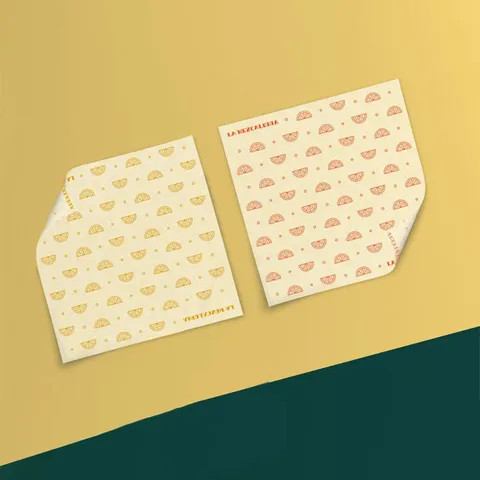
There is a middle path for printed paper. A repeat-printed roll costs less per cover than printed sheets and still shows the logo on every tear. Plain pre-cut sheets suit a kitchen that wants a stack of 24 x 36 in ready beside the smoker.
| Question | Sheets win | Rolls win |
|---|---|---|
| Covers per month | Under about 1,000 | Over about 1,000 |
| Same size every time | Yes | Not needed |
| Printed logo position | Fixed per sheet | Repeat pattern |
| Counter dispenser in place | Not needed | Yes |
| Storage | Flat cartons stack | Rolls stand or rack |
Core, dispenser and the last 50 feet
Rolls come on a standard core that fits counter dispensers with a tear bar. The bar gives a straight edge and a consistent length, which brings real counts close to the table above.
The last 50 ft or so of any roll are tightly curled. They still work for liners and small wraps, but a brisket sheet pulled from the end of the roll fights you. Keep a second roll ready and move the curled end to the sandwich line.
Sheet cartons for pre-cut paper are listed with their sizes on the butcher paper sheets range.
Custom widths and custom sheet sizes
The widths on each product page are the typical four. Anything else is a custom cut. A 20 in roll for a specific dispenser, a 26 x 40 in sheet for a long packer, a 10 x 10 in square for a slider. Ask for it on the quote and the written price comes back within one business day.
Custom sheet math is the same. A 1,000 ft roll slit and sheeted at 40 in gives about 300 sheets per roll width. If the width is also cut down, say two 12 in sheets from a 24 in web, double the count.
Custom widths change the sheet count only if the cut length changes. A 20 in roll torn at 24 in still gives about 500 sheets from 1,000 ft; the sheets are just narrower.
Mistakes in roll math
- Dividing feet by inches without converting; 1,000 divided by 24 is not a sheet count
- Buying 18 in for brisket because it was the cheapest roll, then double-sheeting every wrap
- Forgetting overhang on table covers, so a 36 in roll on a 36 in table looks short
- Sizing a month on a slow week's count
- Ordering one roll of a new width and running out before the next quote is accepted
How to order the rolls you worked out
Take the width from the job list and the roll count from the six steps. Plain rolls need no proof, so production starts when the quote is accepted and runs 4 to 6 business days. The cartons travel free and tracked to any US address and arrive in 2 to 3 business days.
Put the covers-per-day figure in the notes box. It lets us check the roll count and suggest a width change before the quote goes out, which has saved more than one buyer a second order.
If you want to see every roll and sheet size on one page before you decide, the butcher paper sizes chart lists them by product.
Papers in this guide


Questions about this guide
How many 24 in sheets are in a 1,000 ft butcher paper roll?
About 500. A 1,000 ft roll is 12,000 in long, and 12,000 divided by 24 is 500 before any waste.
How many sheets does a 700 ft butcher paper roll give at a 36 in cut?
About 233. The 700 ft roll is 8,400 in, divided by 36.
Does a wider butcher paper roll give fewer sheets?
No. Width does not change the count; only length and cut length do. A wider roll gives the same number of larger sheets.
What width butcher paper roll do I need for a brisket flat?
24 in. A trimmed flat wraps in one 24 in sheet about 48 in long with room to fold.
What width butcher paper roll wraps a whole packer brisket in one sheet?
36 in. On a 24 in roll a packer takes two overlapped sheets instead.
How much butcher paper does one brisket wrap use?
About 48 in of length, or 4 ft. Forty wraps a day is roughly 160 ft a day.
How many butcher paper rolls do I need for a month?
Multiply covers per day by cut length, convert to feet, multiply by open days, add 10 percent, then divide by the roll length and round up.
When do pre-cut sheets make more sense than a butcher paper roll?
Under about 1,000 covers a month, or when every cover must be the same size. Above that, a roll in a dispenser saves labor.
Does a butcher paper roll fit a standard counter dispenser?
Yes. The rolls come on a standard core that drops into counter dispensers with a tear bar. The butcher paper rolls range lists every width.
Can I order a butcher paper roll width that is not on the product page?
Yes. Any width outside the four typical sizes is a custom cut, and the price for it comes on the written quote.
Something else? Ask us on WhatsApp or call (503) 461-4788.
Tell us what you wrap
Send the paper, a size and a quantity, plus a logo if you have one. We reply in writing within one business day with a price and, for printed paper, a free design proof. Prefer to talk? Call (503) 461-4788 or message us on WhatsApp.